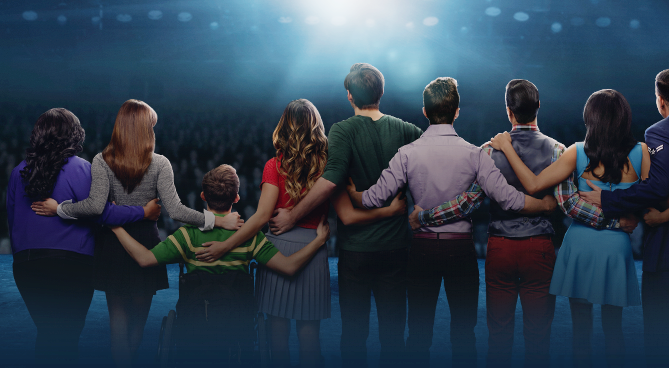
Glee: Stereotypes and Gender Roles
The show Glee is full of stereotypes and expectations. The characters and the setting shows kids and the viewers a false representation of high school and of the students. Every character in the show is a version of who people are expecting to see and interact with in high school. There’s a Jewish girl who hates her nose, a quarterback who has to act tough to be accepted by his peers, a boy who gets bullied for being gay, and mean cheerleaders. Every chance that the show gets, it turns the characters into what society demands and expects from people based on their gender; men are expected to be masculine, athletic, aggressive, and emotionally reserved, while women are expected to be emotional, concerned with their appearance, and maternal. According to an article by The Daily Beast titled, Glee’s Harmful Simplicity, forcing gender roles upon people is damaging, but that’s what Glee does: it accepts society’s definitions and reinforces them.
The show is set at McKinley High school in Ohio. The teacher, Will Schuester, takes on the roll of coaching the glee club. Students from different background and social statuses join the group, and soon after, find the glee club as a safe haven. Schuester helps a group of aspiring underdogs realize their true star potential. The hope that the glee club brought the students in the show was inspiring to its viewers because, afterwards, glee clubs were more accepted in high schools. While this message to the public was celebrated, the representation of the characters was very controversial. Each character represented someone that would be found walking the halls of high school. Of all the students, I found the Asian characters, Mike and Tina, to be the most stereotypical. “Tina and Mike never failed to mention their race and say the word Asian in almost every episode. As a couple, they were both counselors at “Asian camp” and share “Asian kisses,” and when they had trouble in their relationship, they turned to “Asian couples therapy”’ (Kollaboration). As seen in the episode, Asian F, Mike earns an A- in one of his classes, and his father petitions to have him drug tested every day, he blames Mike’s girlfriend, Tina, and demands that his son quits the glee club because he insists that it is a waste of time, but Mike loves to dance. The episode is titled Asian F because the other Asian characters consider an A- an F. This is seen as controversial because the stereotype is that Asian people are very smart, and the show really emphasizes that. Another scene from this episode takes place in the locker room during football practice. The coach yells out, “Listen ladies” to get the boys’ attention, and later on, one of the black football players says, “My daddy didn’t raise me to be a ballerina, in fact, he didn’t even raise me.” Which, as stated by The Washington Post, plays on the “dangerous myth of the missing black father”. This specific episode is overflowing with scenes and dialogues that would not be accepted in 2019.
Ryan Murphy, the director of Glee, American Horror Story, and Scream Queens, was able to establish a mini empire of television development. He was the embodiment of future television, but Murphy’s method of grabbing an audience is “either caustic, ironic humor, or horrifically awful sexualized violence. And it appears that each time he deploys a shock missile, his next one has to be twice as shocking. The result is a body of work that exploits as a prop and then quickly disposes of any number of actual social ills and real issues of oppression: rape, racism, homophobia, disability, eating disorders, murder. It’s possible to make art out of narratives of violence, offense, and horror, but I am really not sure if art is what we’re watching” (The Salon). Ryan Murphy is a openly gay man who came out to his parents at age fifteen while he was in high school. In season one, the character Kurt, who is gay but has not yet come out, struggles with who he is. He tries to hide behind flannels and country music. When he does come out as gay later in the show, he gets bullied by football players and other students, and he has to learn how to love himself for who he is. The characters embrace Kurt’s derivation from gender norms, and that has a positive impact. Ryan Murphy wanted to have his own experiences become the character (NewNowNext). This was a great way to make a character more realistic, but it turns out that Murphy wasn’t originally planning on having a gay character in the show. It was only when he was auditioning that he thought it was kind of ridiculous that they were “doing a musical about kids and expression and they didn’t have the gay point of view” (NewNowNext). Murphy says “I’ve done other shows with gay characters, and I will say that in many of those cases, the gay characters didn’t have happy endings. And I thought you know what? Enough” (NewNowNext). While Murphy is able to send his message to viewers with a male gay character, he doesn’t portray gay women in the same inspirational way. The characters Santana and Brittany, are both queer and in a relationship together. We see clips in the show of them kissing, and their relationship is highly sexualized, which is a good example of how badly women are portrayed in the show.
Glee received a lot of hate from viewers based on how they have been portraying women. The characters are mostly vain, focused on their love interests, or obsessed with themselves (WMC). “One of the most damning examples is the character of Terri Schuester, who’s married to glee club adviser Will Schuester. As played by Jessalyn Gilsig, Terri is “the shrewish, nagging wife from hell,” as Maureen Ryan of the Chicago Tribune wrote. The character confirmed our worst fears about women—that they’re devious and trying to force men into lifelong relationships the men don’t want—when she and her sister conspired to trap her unhappy husband in their relationship by pretending to be pregnant. When the fake pregnancy was finally revealed, Glee’s writers used that as an opportunity for a little violence against women—Will angrily grabbed her wrist and shoved her backwards—and worse, that’s violence [that] the audience might actually support because of Terri’s awful behavior” (The Daily Beast, Glee’s Harmful Simplicity). University of North Carolina at Chapel Hill professor Julia T. Wood writes in Gendered Lives that even though “the historical trend of emphasizing gender-stereotyped roles and images continues today … it is sometimes challenged by alternative images of women, men, and relationships.” When Sue Sylvester, the cheerleading coach in Glee, pursued a relationship with a man, she softened, becoming conciliator. When the relationship ended, she reverted back into her hyper-masculine, aggressive, and vicious ways. And there is the ugly stereotype: women need men to calm them down (The Daily Beast, Glee’s Harmful Simplicity).
Although Glee has controversial characters and scripts, the show has reached millions of fans across the country with its likeable characters, musical covers, and adolescent relatability. My family and I used to watch Glee while it aired on television, and we all enjoyed the show because it was entertaining, but as I have analyzed the show, I have found many regressive elements. Glee took society’s definitions of people and reinforced them. They focused on one trait from each character that stood them apart from everyone else and exaggerated it. Yet even as Glee celebrated attributes that would typically attract jokes or taunts, the series reached for the ugliest gendered stereotypes imaginable (The Daily Beast, Glee’s Harmful Simplicity).
 Glee: Stereotypes and Gender Roles